
The Spirit of the 1993 Ferrari 512 TR
The 1993 Ferrari 512 TR represents a perfect harmony between raw performance and refined design. Introduced as a successor to the iconic Ferrari Testarossa, this model sharpened every edge—mechanically and aesthetically. Designed by Pininfarina, powered by a naturally aspirated 4.9-liter flat-12 engine, and driven through Ferrari’s famous gated manual gearbox, it stands as one of the most desirable analog supercars of the 1990s.


Design & Aerodynamics by Pininfarina
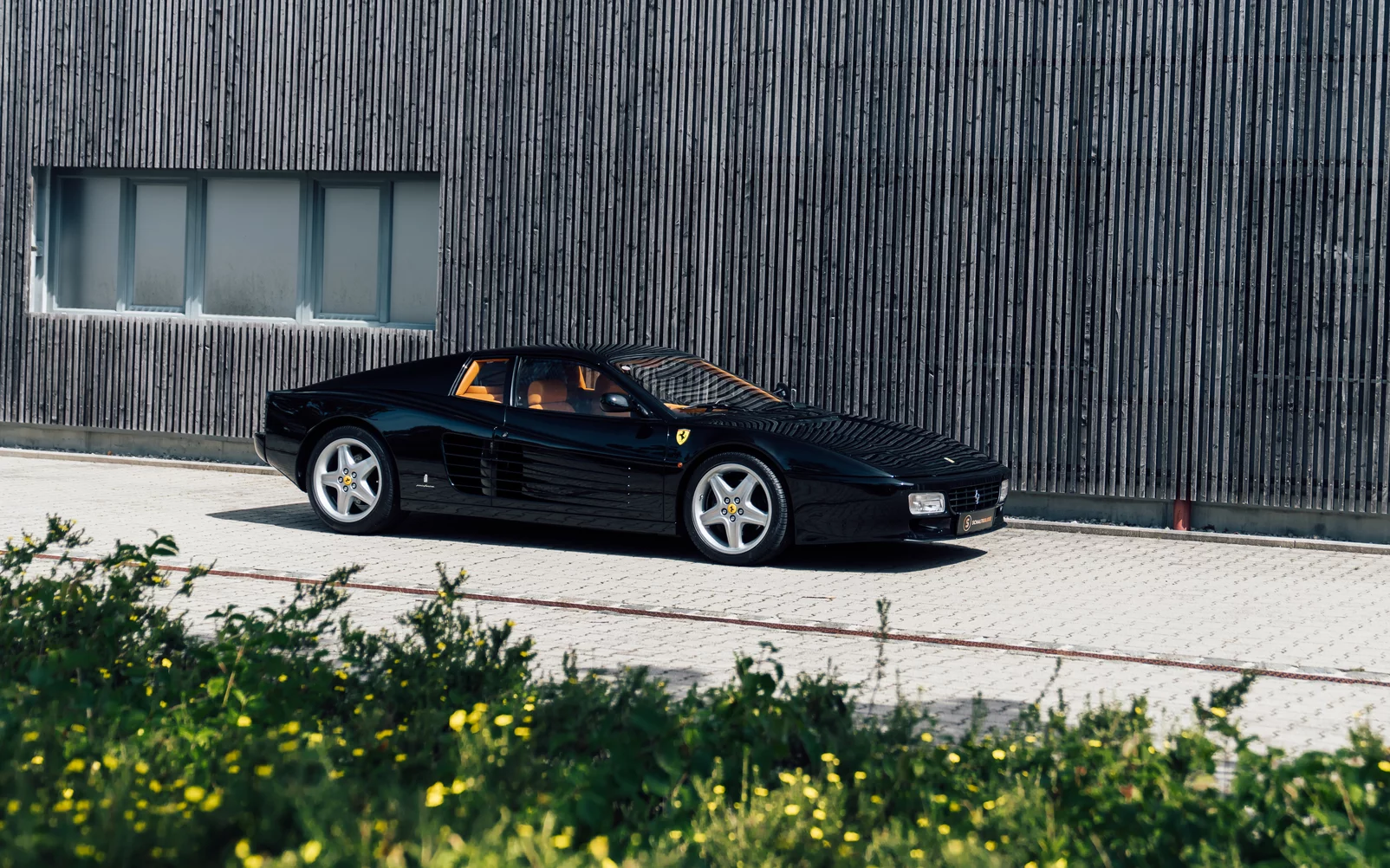
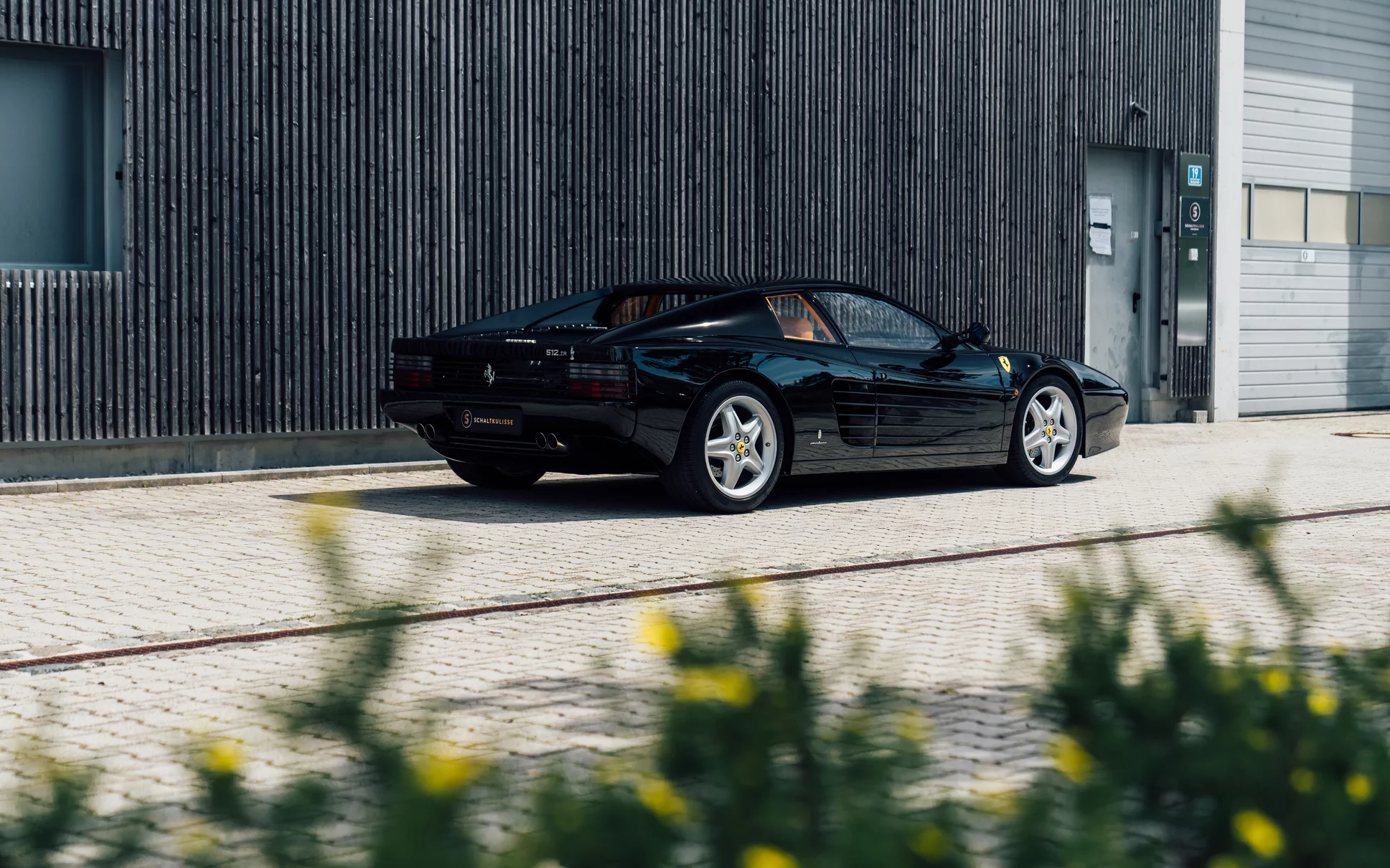
The Ferrari 512 TR kept the Testarossa’s dramatic silhouette—wide rear haunches and signature side strakes—but introduced smoother, more integrated lines that improved both looks and aerodynamics.
Inside, Ferrari refined the ergonomics. The steering wheel, pedals, and gear lever were repositioned for a better driving position, while tan leather wrapped the cabin in typical Italian luxury. The example featured here wears Nero (FER 1240)paint with a tan interior—an elegant, high-contrast specification that perfectly complements its classic 1990s aesthetic.
Engine & Performance: The Flat-12 Powerhouse
At the heart of the 1993 Ferrari 512 TR lies a 4,943 cc flat-12 engine, producing 428 hp (315 kW) at 6,750 rpm and 491 Nm of torque at 5,500 rpm.
That power launches the car from 0–100 km/h in just 4.9 seconds, with a top speed of 314 km/h. Improvements in cylinder heads, intake geometry, and engine mapping gave it smoother delivery and stronger mid-range punch compared to the earlier Testarossa.
The 5-speed gated manual transmission remains one of Ferrari’s most tactile and engaging gearboxes ever made. Its precision and mechanical feedback make every shift a deeply satisfying experience—one reason collectors treasure the 512 TR today.


Engineering & Handling Upgrades
Beyond raw power, Ferrari engineers refined nearly every mechanical aspect.
-
Improved chassis rigidity boosted cornering stability.
-
Revised suspension geometry enhanced handling response.
-
Bigger brakes delivered stronger stopping power.
-
Better weight distribution (41/59) increased agility.
-
Lower ride height and revised tires improved traction and aerodynamics.
This made the 512 TR far more balanced and confidence-inspiring than the original Testarossa—especially at high speeds or during spirited cornering.

Heritage: From Testarossa to Timeless Classic
The Ferrari 512 TR debuted in 1991 as a major evolution of the Testarossa, continuing production until 1994 before being succeeded by the F512 M.
It refined the Testarossa’s flamboyant character into something sharper and more mature—still exotic, but more cohesive and driver-focused. Over 2,200 examples were produced, making it exclusive but not unattainable.
Collectors value the 512 TR for its perfect balance of usability and classic Ferrari character. It remains one of the last Ferraris powered by the legendary flat-12 engine, a layout Ferrari would never revisit again in road cars.


The 1993 Model Year: The Sweet Spot
The 1993 model year represents the pinnacle of refinement for the 512 TR. By this time, Ferrari had fine-tuned build quality and component reliability. The car benefited from:
-
Optimized engine mapping and smoother throttle response
-
Enhanced cabin materials
-
Updated cooling and braking systems
-
Minor electrical improvements
As a result, 1993 models are often considered the most desirable for those seeking to both drive and collect.

Interior: Analog Perfection
Step inside the 512 TR and you’re transported to an era of pure mechanical engagement.
Every element—the gated shifter, the analog dials glowing red, the three-spoke steering wheel with the yellow prancing horse—speaks to Ferrari’s philosophy of simplicity and precision.
Modern supercars may boast touchscreens and drive modes, but few can replicate the raw, tactile satisfaction of slotting gears through that open-gate metal shift plate.
Maintenance & Ownership Considerations
Owning a 1993 Ferrari 512 TR requires care and expertise. Maintenance is key to preserving both reliability and value.
Essential service points:
-
Timing belt service every 5 years or 30,000 km
-
Regular fluid changes (engine, gearbox, brakes, coolant)
-
Valve clearance checks
-
Proper flat-12 tuning by a Ferrari-certified specialist
Cost note: A full engine-out service can range between $8,000–$12,000, depending on parts and labor. However, with diligent maintenance, the 512 TR remains one of the most reliable classic Ferraris.
Pop-Culture Icon & Legacy
The Ferrari 512 TR and its predecessor, the Testarossa, became global icons thanks to appearances in film, television, and music throughout the late ’80s and ’90s.
Its instantly recognizable design—with that wide rear stance and deep side strakes—cemented its image as the ultimate exotic supercar of the era. Today, the 512 TR still commands attention wherever it goes, embodying a time when driving was visceral, analog, and purely emotional.
Why the 512 TR Still Matters Today
In a world dominated by turbocharged, hybrid, and electric supercars, the 1993 Ferrari 512 TR remains refreshingly raw.
-
No driving aids, just driver skill.
-
Manual shifting, not paddles.
-
Mechanical feedback, not digital screens.
This authenticity is why the 512 TR has transcended time—it’s not just a car, it’s an experience. A direct link to an era when Ferrari focused on emotion, not electronics.
Summary: The Refined Italian Masterpiece
The 1993 Ferrari 512 TR is more than an evolution—it’s a masterpiece that defines an era. With its breathtaking design by Pininfarina, thunderous flat-12 engine, and timeless allure, it captures everything enthusiasts love about classic Ferraris.
Whether admired as a collectible or driven on open roads, the 512 TR delivers an intoxicating mix of art, engineering, and performance.
If you seek the soul of 1990s Ferrari—the look, the sound, the feel—there’s no better choice than the 1993 Ferrari 512 TR.